
Sigmar Polke and Blinky Palermo met at the Düsseldorf Art Academy in 1962 and became friends. Polke studied under Gerhard Hoehme, and Palermo was a master student of Joseph Beuys. The presentation at Museum Küppersmühle is a concentrated juxtaposition of larger groups of works by the two then young artists from the Ströher Collection.
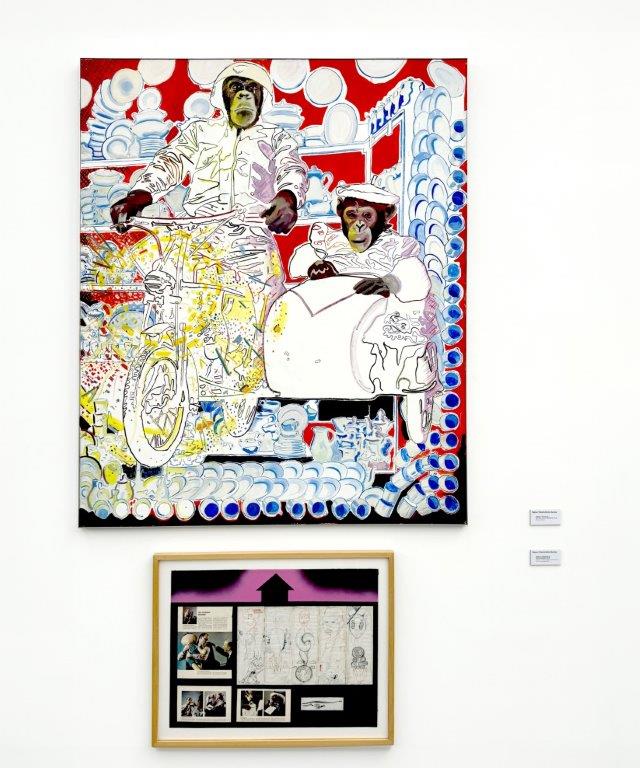
With the 38-part series Original + Forgery (created with the collaboration of Achim Duchow), Sigmar Polke questions the truth and credibility of images with subtle humor and creates a work of the highest complexity and ambiguity – a contribution to a history of seeing and understanding that is as clever as it is ironically biting. It is not only about art theft, but also about the question of authorship, authorship, the role of the media and the viewer – topics that are very topical today in view of lively discussions about collective and individual responsibility. Sigmar Polke already addressed questions that we deal with every day in our daily interaction with the media 50 years ago, long before the use of artificial intelligence in the field of imaging. Original + Fälschung has lost none of its power to this day with its wit, the numerous alchemically fused pictorial ideas and montages of thoughts and their equally snotty and precise execution.
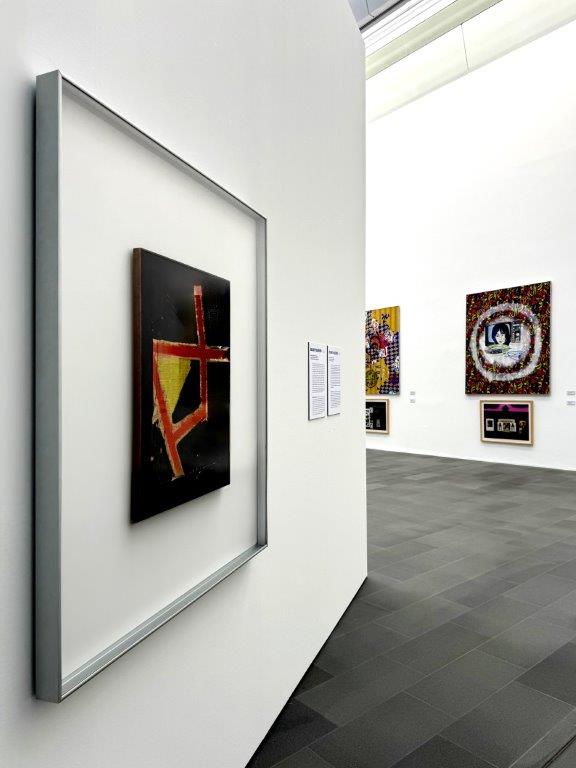
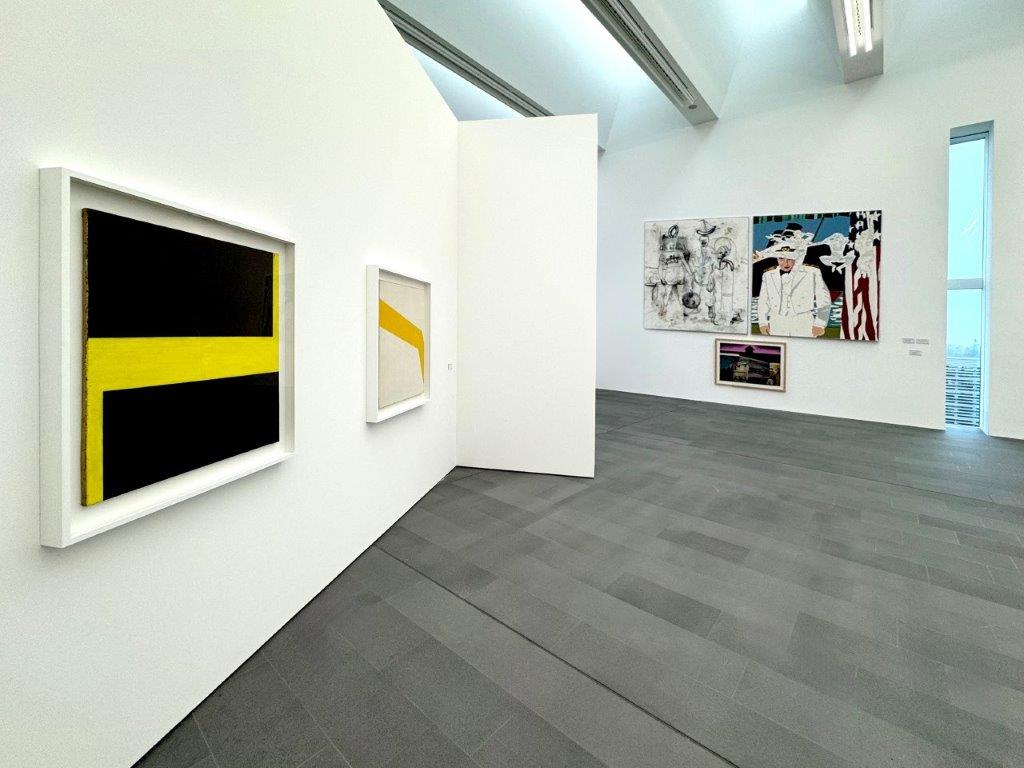
Blinky Palermo’s work did not pursue social themes like Polke’s work, but rather reveals his engagement with the aesthetic debates of his time; for example, understanding a work of art as a concept and not just as an object on the wall. His interest focused on elementary colors and shapes such as squares and triangles, with which he explored the relationships between surface, space and time. Later, Palermo dispensed with oil paint altogether and used colored fabrics from department stores.
The adoption of materials from mass production and techniques from the advertising industry, such as screen printing, link Palermo’s and Polke’s otherwise very different practices These strategies, also known from American Pop and Minimal Art, were perceived as radical and provocative.
Both Polke and Palermo quickly attracted international attention. On a personal level, Blinky Palermo was both likeable and busy and at the same time very modest. Some saw him as the James Dean of painting, and his first exhibitions were flops. He died in the Maldives at the age of just 33, and the circumstances of his sudden death remain unclear to this day. Unlike his teacher Joseph Beuys, Palermo avoided the grand gesture. He did not explain his works, but stated: “I have no program”. His work defies art historical classification in terms of classical genres and methods. He is considered an early accomplished artist whose work, together with that of Imi Knoebel, set standards that continue to have a great influence on younger artists today.
Never before have Sigmar Polke and Blinky Palermo been presented in the same room – two friends without whom the development of German art would have taken a completely different course. The freshness and immediacy of her works continue to this day.
Blinky Palermo’s work did not pursue social themes like Polke’s work, but rather reveals an engagement with the aesthetic debates of his time; for example, understanding a work of art as a concept and not just as an object on the wall. His interest focused on elementary colors and shapes such as squares and triangles, with which he explored the relationships between surface, space and time. Later, Palermo dispensed with oil paint altogether and used colored fabrics from the department store. The adoption of materials from mass production and techniques from the advertising industry, such as screen printing, combine Palermo’s and Polke’s otherwise very different practices. These strategies, also familiar from American Pop and Minimal Art, were perceived as radical and provocative.
Both Polke and Palermo very quickly attracted international attention. On a personal level, Blinky Palermo was both likeable and busy and at the same time very modest. Some saw him as the James Dean of painting, and his first exhibitions were flops. He died in the Maldives at the age of just 33, and the circumstances of his sudden death remain unclear to this day. Unlike his teacher Joseph Beuys, Palermo avoided the grand gesture. He did not explain his works, but stated: “I have no program”. His work defies art historical classification in terms of classical genres and methods. He is considered an early accomplished artist whose work, together with that of Imi Knoebel, set standards that continue to have a great influence on younger artists today.
Never before have Sigmar Polke and Blinky Palermo been presented in the same room – two friends without whom the development of German art would have taken a completely different course. The freshness and immediacy of her works continue to this day.